In recent years, the "dual-use item license" has been a headache for titanium and titanium alloy production enterprises.
Firstly, what is a 'dual-use item license'? Goods, technologies, and services that serve both civilian and military purposes, or contribute to enhancing military potential, particularly those that can be used for the design, development, production, or use of weapons of mass destruction and their means of delivery.
On November 15, 2024, the Ministry of Commerce, the Ministry of Industry and Information Technology, the General Administration of Customs, and the State Cryptography Administration jointly issued Announcement No. 51 of 2024, announcing the "Export Control List of Dual Use Items of the People's Republic of China", which will be implemented from December 1, 2024. On the same day, 11 old announcements (including Announcement No. 5 of 2003 by the Ministry of Commerce and the General Administration of Customs) were abolished in one go.
The most important point for titanium production enterprises is that titanium metal is fully listed: iron, chromium, copper, aluminum, nickel, tungsten, molybdenum, antimony, cobalt, lithium, zirconium, titanium, niobium, tantalum, beryllium, germanium, gallium, indium, hafnium, rhenium, phosphorus, graphite and other metal related items are all included in the control list.
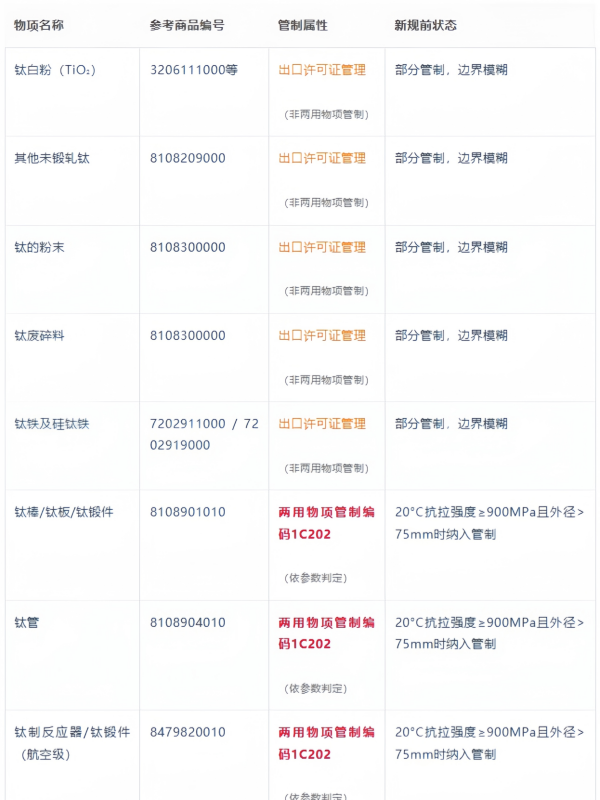
On December 30, 2025, the "Catalogue of Goods Subject to Export License Administration (2026)" (Announcement No. 89 of 2025 by the General Administration of Customs of the Ministry of Commerce) and on December 31, 2025, the "Catalogue of Goods Subject to Import and Export License Administration for Dual Use Items and Technologies" (Announcement No. 91 of 2025 by the General Administration of Customs of the Ministry of Commerce) specify that the export of titanium and titanium containing items requires a license:
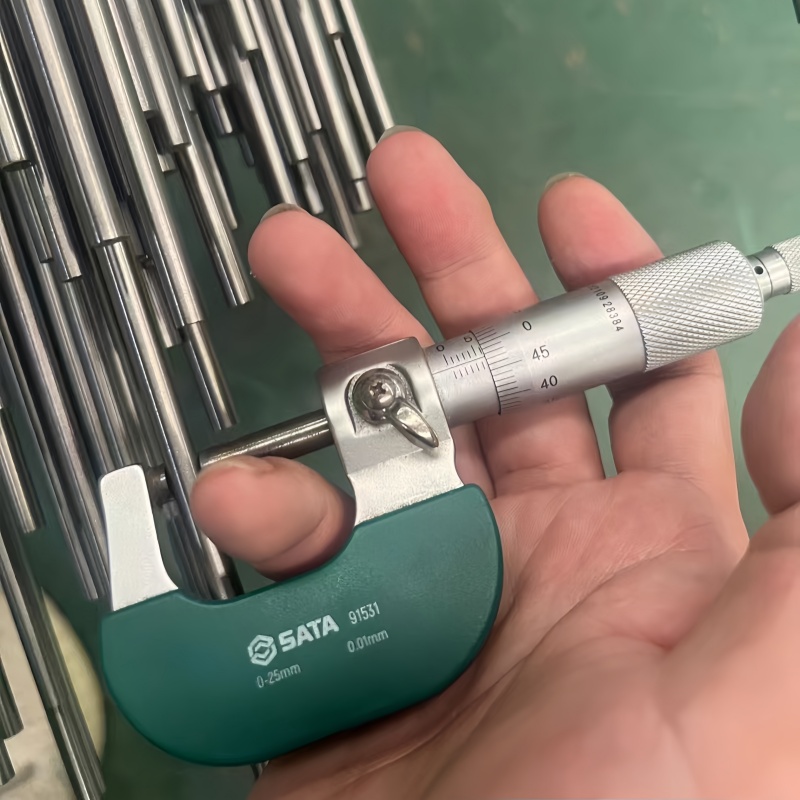
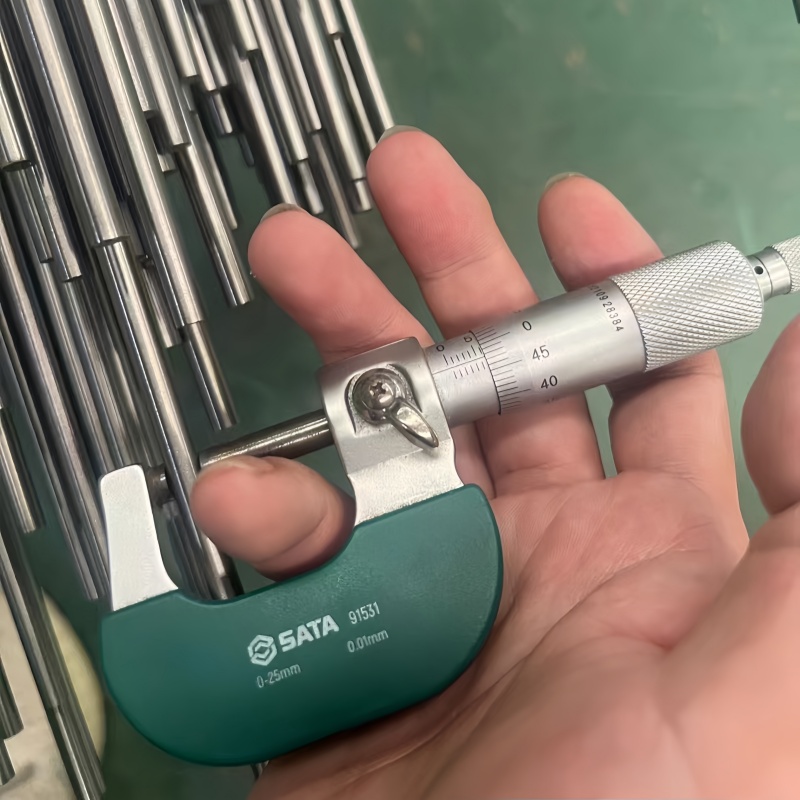
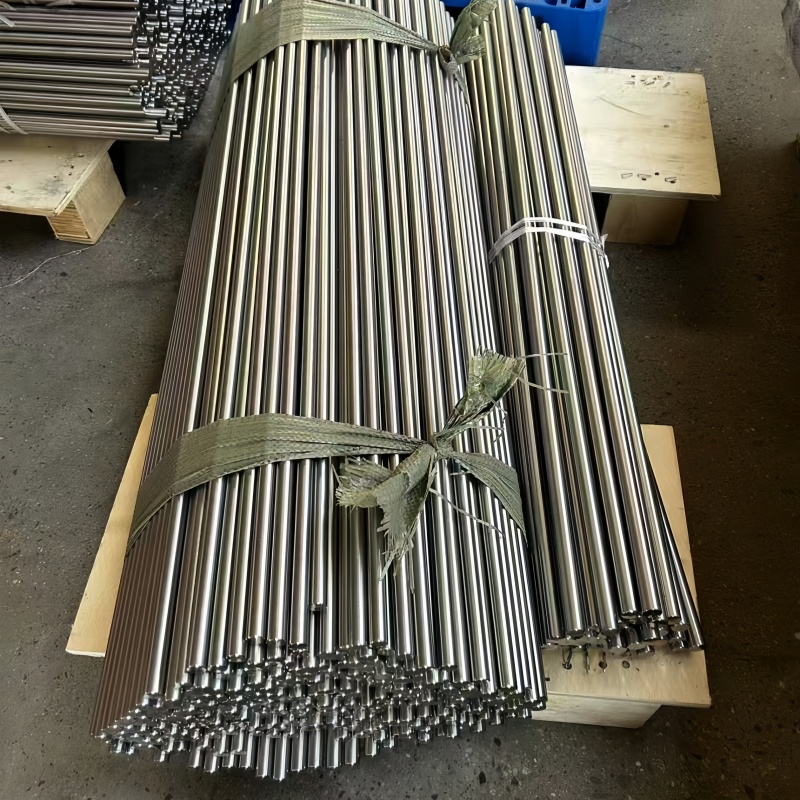
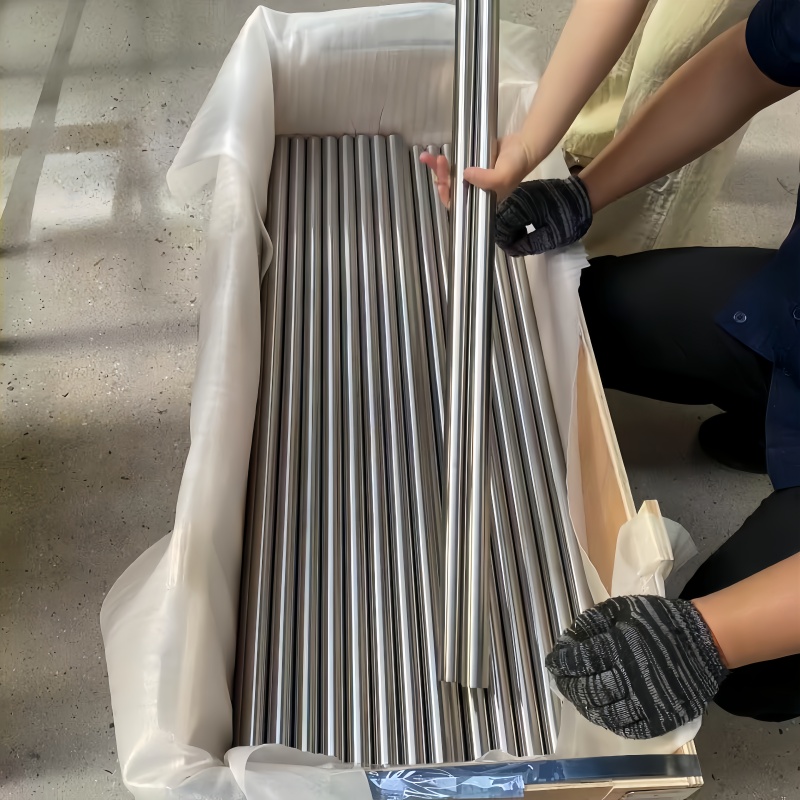
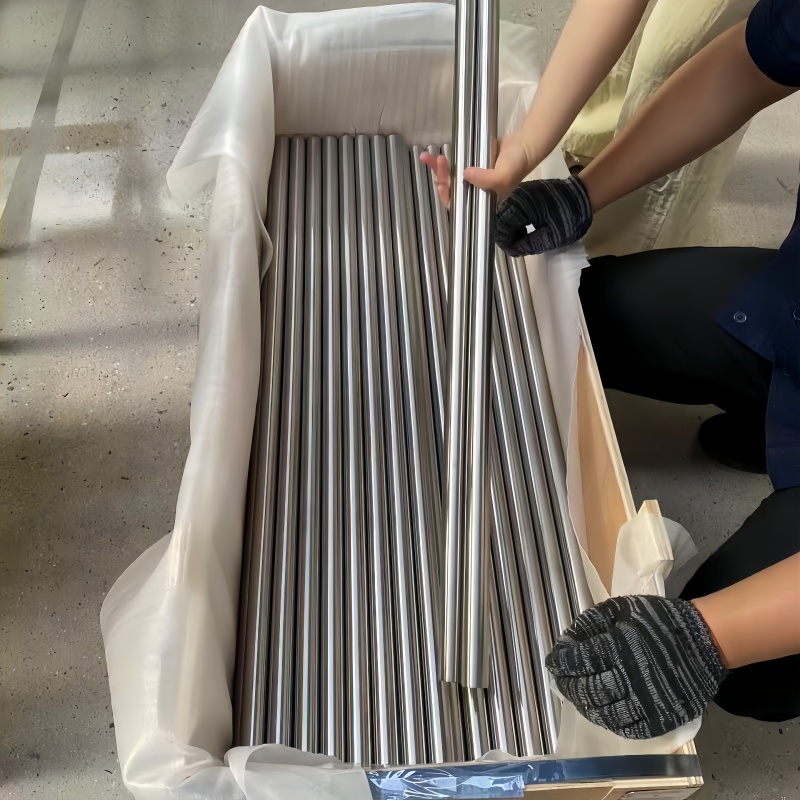
Taking titanium rods as an example, titanium rods under code 8108901010 have a tensile strength of ≥ 900MPa and an outer diameter greater than 75mm when they simultaneously meet 20 ° C, and belong to dual-use item control code 1C202. The compliance boundary is precisely locked by the parameters.
How can titanium material production enterprises apply for a "dual-use item export license"? The following is the standard process for titanium metal enterprises to apply for dual-use export licenses, based on the official guidelines and practical experience of the Ministry of Commerce:
Step 1: Item Identification
1. Compare the "Control List" to confirm whether the product belongs to controlled items (five digit code query)
2. Confirm the corresponding 10 digit HS code by comparing it with the "Management Catalog"
3. For products with "critical" technical parameters, entrust a third party to test and issue a report
If unable to make a self judgment, you can submit a "Business Consultation Letter" to the Ministry of Commerce (apply within the system, reply without time limit)
Step 2: System registration
1. Login to the unified platform of the business system of the Ministry of Commerce: https://ecomp.mofcom.gov.cn
2. Apply for an electronic key (CA certificate) and bind it with the company seal
3. Fill in the basic information of the enterprise, upload the business license, and the registration form for foreign trade operators
4. Wait for account activation (usually completed on the same day)
Step 3: Core Material List:
1. Application Form for Export License of Dual Use Items
2. Copy of the business license of the enterprise
3. Registration Form for Foreign Trade Operators
4. Copy of export contract (signed and stamped by the signing party)
5. Item technical specifications or third-party testing reports
6. Original "End User and End Use Certificate" (including Chinese translation, signed and stamped by the end user)
7. Introduction to Importers and End Users (including Chinese translations)
8. Identity proof of legal representative and agent
Step 4: Submission and Approval
1. Online submission: All scanned copies of materials are uploaded to the business system of the Ministry of Commerce
2. Paper submission: Original copy of "End User and End Use Certificate"+paper version of "Application Form", submitted to the provincial commerce authority (no need to go to the Beijing headquarters of the Ministry of Commerce)
3. Provincial preliminary review → Ministry of Commerce final review (decision to be made within 45 working days, may be extended in special circumstances)
4. The approval progress can be queried in real-time in the system
5. Free of charge throughout the process (for administrative licensing matters, no handling fees will be charged)
Step 5: License and Customs Declaration
After approval, the Ministry of Commerce generates an electronic approval form
2. Enterprises can obtain the "Dual Use Item Export License" from the provincial commerce department with the approval form
3. The license is an electronic certificate, and the enterprise can declare customs with the license number (customs online verification)
4. The validity period of the license is usually 6-12 months, and the export must be completed within the validity period.
Compliance is not a burden, but a "passport" for titanium and titanium alloy enterprises to enter the international market. Under the framework of the "Regulations on the Export Control of Dual Use Items of the People's Republic of China", as long as enterprises solidly follow the four steps of "item identification material preparation system application subsequent management", they can minimize export risks and enjoy the efficiency improvement brought by convenient measures such as general licenses and export certificates.
Starting today, all production enterprises will take action: designate a dedicated person to be responsible for export control affairs, establish a complete product technical file and internal compliance ledger, regularly organize training, and maintain communication with provincial commerce authorities and professional compliance agencies. When encountering uncertain technical parameters, it is better to ask for more business consultation than to take the risk of clearing customs. Implement compliance in daily life and keep risks at bay. Only in this way can the titanium and titanium alloy industry truly achieve high-quality and sustainable export development while maintaining national security.
 +86-0917-3217876
 18292732691
 No. 28, Middle section of Baotai Road, Gaoxin Developing District, Baoji, Shaanxi
 marketing@ymdtitanium.com
 www.ymdtitanium.com


 English
 简体中文

 18292732691
 marketing@ymdtitanium.com
 zyh2968808781
 +86 18292732691
 .cid.b0f8e930cd0ba28e
